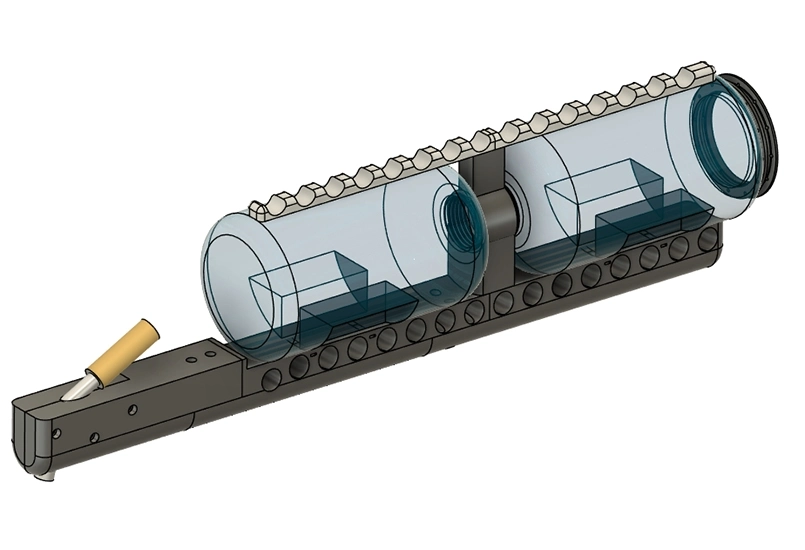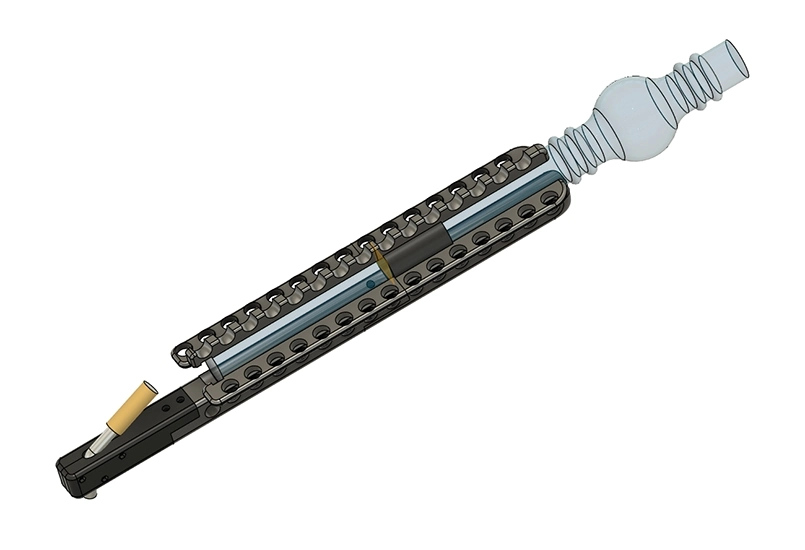
A butane gas powered flame and sound effect prop
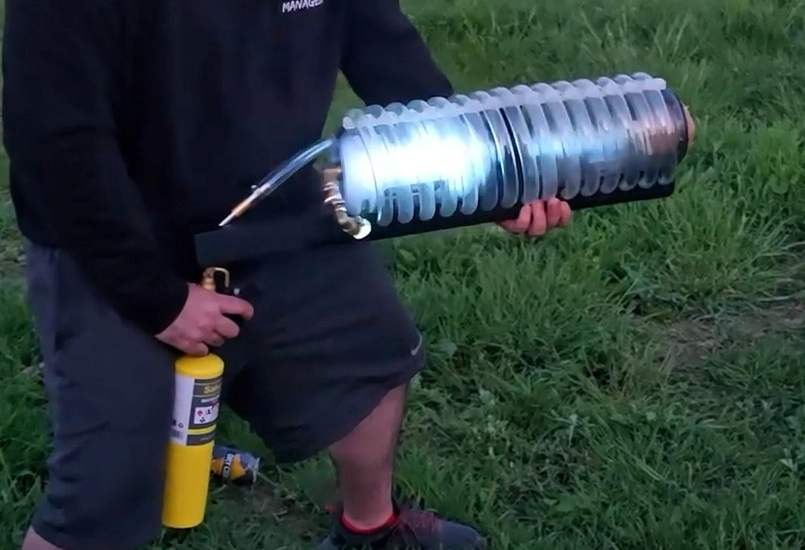
Like many of my projects, this one started with seeing something online and thinking two things almost simultaneously. First, that looks incredible. Second, why does it look so rough? The original inspiration was a short video of a very rudimentary build. Two plastic bottles taped together, a clear tube loosely wrapped around them, all mounted on a bit of wood and fed by a plumber’s gas torch. When fired in low light, the effect was undeniable. A visible flame chased its way around the spiral before blasting through the centre with a loud, chest-thumping pop. It looked like a sci-fi plasma weapon brought into the real world.
Visually, though, it left a lot to be desired. Gaffer tape, exposed fittings, and rough construction took away from the illusion. That gap between effect and execution was the hook. If the underlying principle was that simple, then surely it could be rebuilt to look intentional, engineered, and properly sci-fi.
The first decision was to abandon the improvised aesthetic entirely. No wood. No tape. No loosely wrapped tubing. Everything would be designed, printed, and assembled as a complete object. The goal was not to reinvent how the effect worked, but to refine how it was presented.
At its core, the system is simple. Butane gas from a standard plumber’s soldering torch feeds into a clear tube. The gas ignites at the torch and the flame visibly propagates through the tube before exiting through a central chamber with a loud pop. That pop comes from forcing the flame through a reduction between two larger volumes, exactly like the bottle-neck effect seen in the original builds.
What changed was how every one of those elements was held, aligned, and shaped.
Rather than build a single version, I built three. One used large sports water bottles as the inner chambers, another used a clear plastic bong tube chosen purely for its retro sci-fi shape, and the third used a thick acrylic tube left over from another project. Each version explored a slightly different scale and visual language, but all followed the same internal principle.
Custom 3D printed couplers replaced tape entirely. For screw-neck bottles, the couplers allowed the containers to be joined end-to-end cleanly while also acting as reducers. For the acrylic and bong tube versions, printed reducers stepped the internal diameter down sharply to create the pressure change needed for the pop. The inner chamber became a deliberate acoustic component rather than an accidental one.
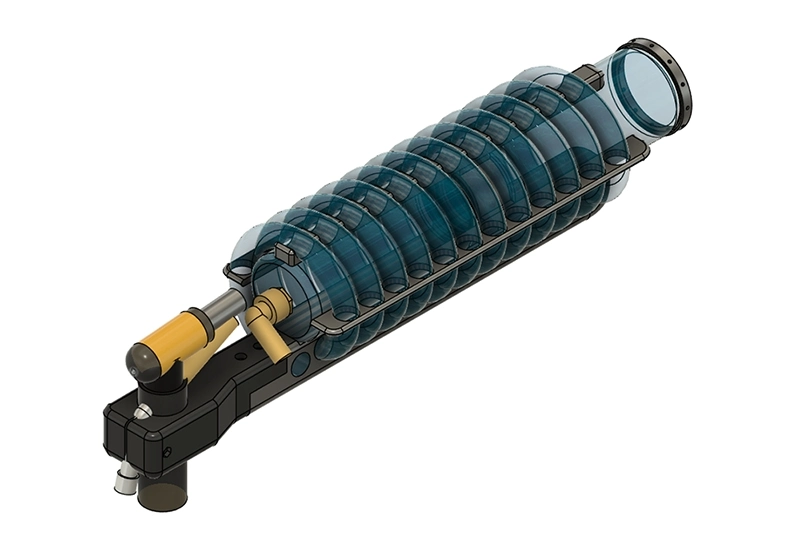
The biggest visual upgrade came from the receiver. Instead of wrapping tubing by eye, the handguard was designed to do three jobs at once. It supported the inner chamber, clamped the plumber’s torch securely, and acted as a precise guide for the helical tube.
Using CAD, a spiral path was built directly into the receiver so the clear tube would wrap evenly, consistently, and symmetrically around the core. The result was a clean, evenly spaced coil that looked engineered rather than improvised. This was where the project shifted from a novelty experiment to something that genuinely resembled a retro sci-fi prop.
If there is one lesson from this project, it is that tubing matters more than expected. Clear plastic tubing arrives coiled in large loops, but forcing it into a much tighter spiral causes it to kink, flatten, and restrict flow. Those restrictions are fatal to the effect. A single pinch is enough to stop the flame dead.
Different diameters were tested. Half-inch tubing kinked badly. Three-quarter-inch tubing behaved better but still suffered under tight bends. Brass plumbing elbows helped in a few tight transitions, but the main spiral remained the weak point. When the tubing was warm and perfectly open, the effect was spectacular. When it cooled or shifted slightly, ignition became unreliable.
Everything else worked. The torch, the chambers, the reducers, the receiver, the grip. The tubing alone determined success or failure.
Despite the reliability issues, the payoff was undeniable. Fired outdoors at dusk or in darkness, the Gas Flame Popper draws immediate reactions. The visible flame racing through the spiral, the sudden pop, the heat, the sound, and the physical feedback combine into something far more impactful in person than on video. Everyone who saw it wanted to try it. Everyone described it the same way. It felt like firing a sci-fi weapon.
This project is a success with an asterisk. Visually, mechanically, and conceptually, it achieved exactly what it set out to do. Practically, the tubing problem remains unresolved. The builds exist, they look fantastic, and they work intermittently. Solving the tubing issue, possibly through rigid heat-formed clear pipe, is the remaining step.
Like many projects, it now waits on the back burner. Not abandoned, not failed, just paused until the right space, tools, and time come together to finish it properly.