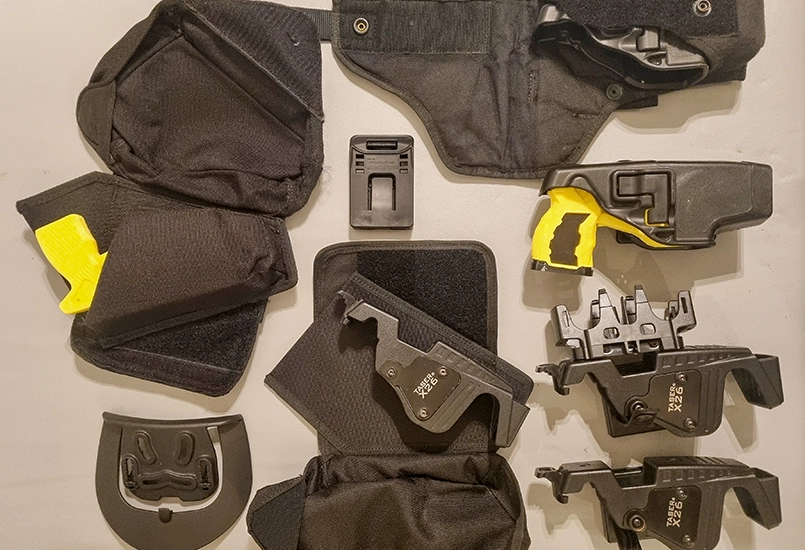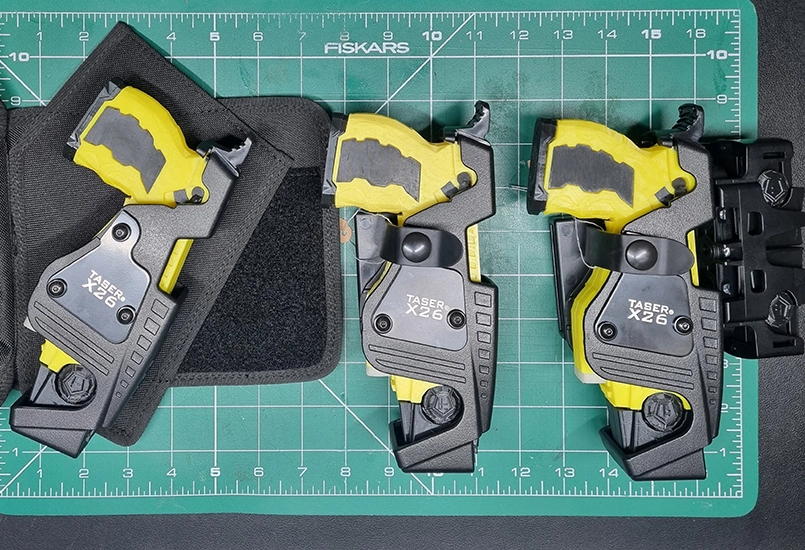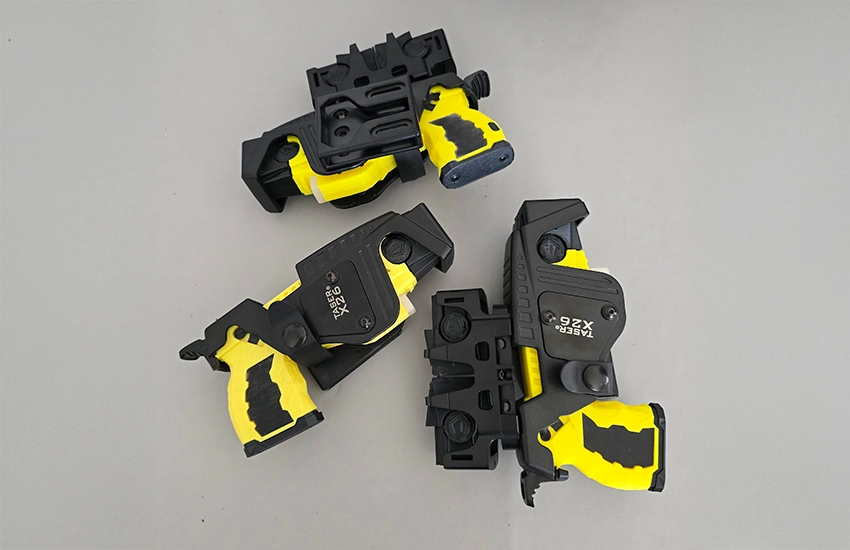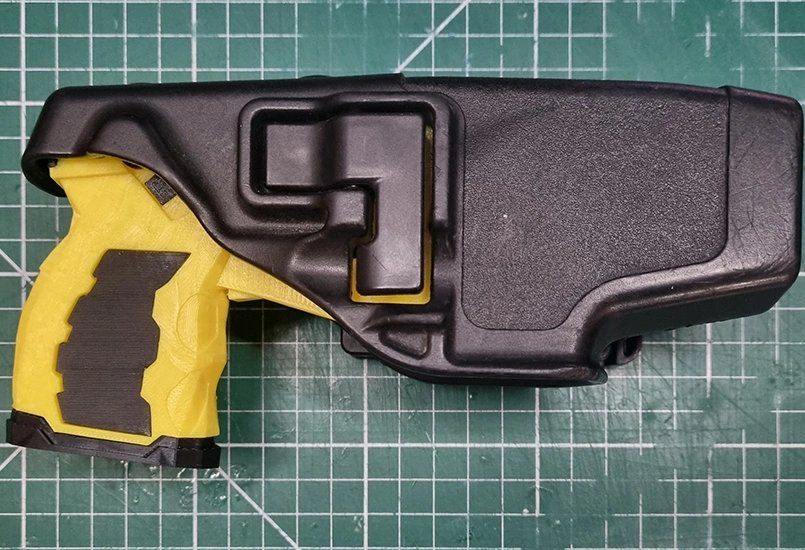
Replica X26 Taser (non functional prop) for airsoft, TV, film and training use
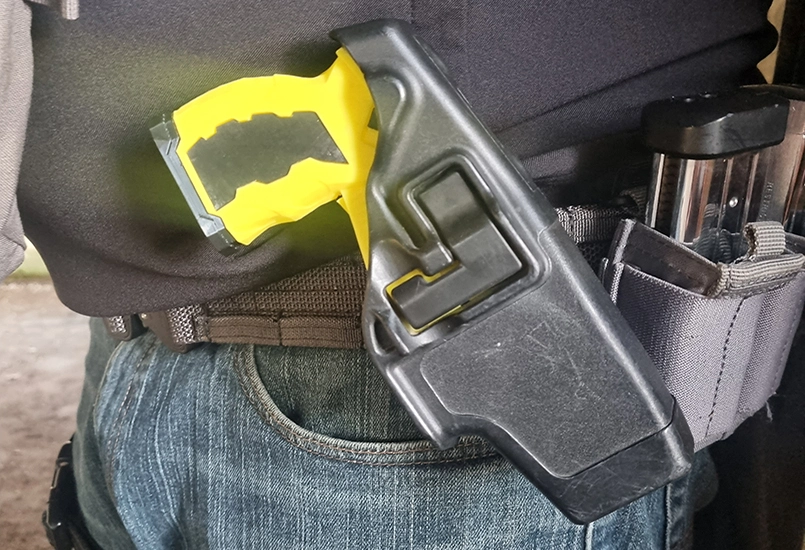
The X26 Taser started as a small idea within an airsoft loadout rather than a standalone project. A friend was building a police SWAT themed kit and wanted a realistic alternative to the standard rubber knife used for close-range eliminations. The concept was simple: replace the existing “knife kill” mechanic with a replica X26 and the call “Taser, Taser, Taser”.
This did not require new electronics or game systems. It only required a believable physical object and a shared agreement between players.
The first practical step was sourcing genuine holsters. UK police no longer issue the X26, which meant surplus X26 Taser holsters were widely available online. A bulk job lot on eBay unexpectedly included a genuine Blackhawk holster alongside standard issue and canvas variants, immediately fixing the physical constraints of the build.
The replica would have to match real-world dimensions and fit authentic equipment.
A one-to-one scale 3D model of the X26 was found, but it was supplied as a single solid mesh. To achieve realistic colour separation, the model had to be manually broken into individual components so the yellow body and black furniture could be printed separately in ABS.
The early prints were functional but clumsy, with small alignment and finishing issues that only became obvious during physical assembly.
Rather than a single build, fifteen units were produced using the same holsters. Each one improved through repetition. By the final version, the fit, finish, and assembly process had converged into something consistent and reliable.
The fifteenth unit was given to its intended user, whose reaction and in-game feedback confirmed the core goal had been met.
Photos of the finished replicas posted online led to interest from UK police departments and a film production requesting multiple units for training and props. While this validated the realism of the design, the project remained intentionally small-scale.
The value was in the prototype, the learning, and the craft, not in turning it into a production line.
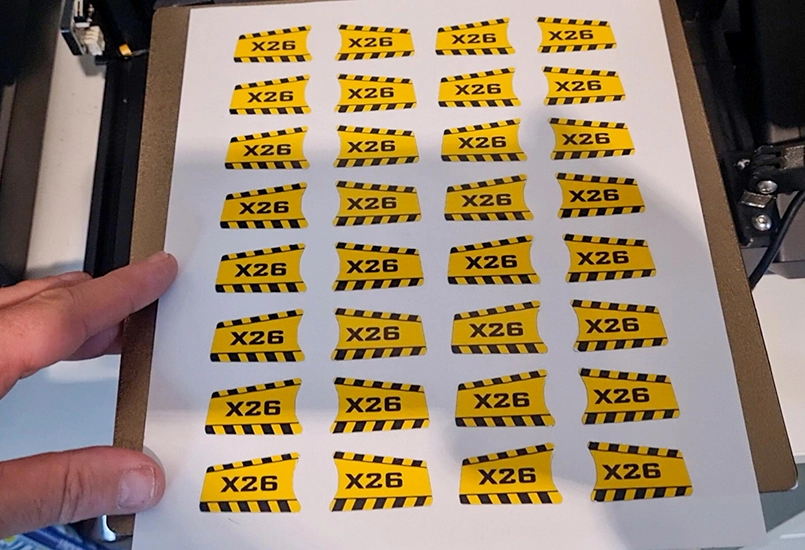
The only non-printed part was the X26 label itself. Instead of a flat sticker, a polyurethane domed badge was created using a DIY resin doming kit. The result added a subtle but critical layer of realism that elevated the prop beyond a typical 3D print.
The project reinforced a recurring principle across many builds: real design happens through making. Planning defines direction, but repetition defines quality.