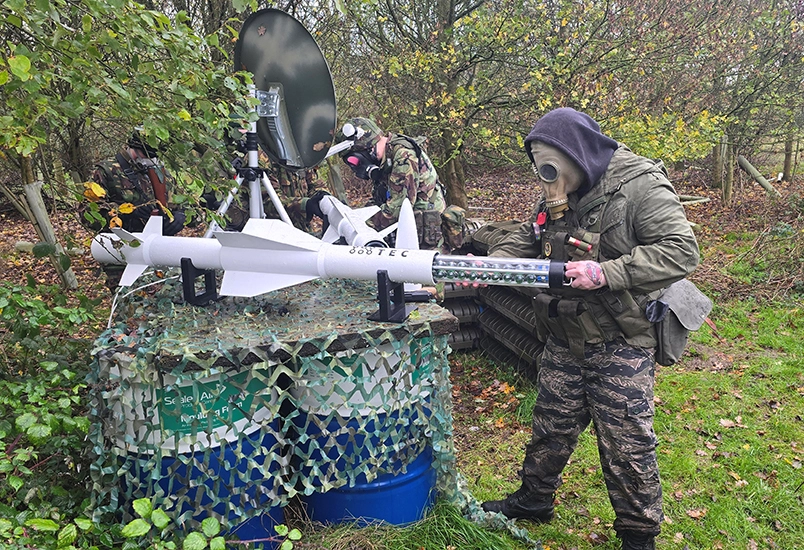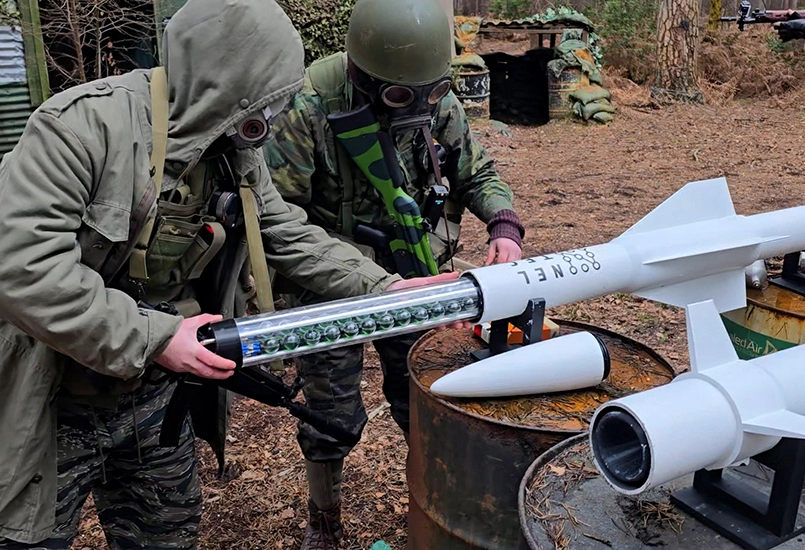
Replica of the VX gas balls from the movie "The Rock"
The VX gas canister was never intended as a standalone prop. It exists because of the Rapier missile launcher project. While building the launcher and its missiles, spare soil pipe made it possible to construct two additional missiles beyond the original set. Rather than discard them, the question became how to turn those extra missiles into something meaningful rather than decorative.
The answer came from the movie called The Rock. The VX gas disarm sequence offered a way to introduce tension, care, and consequence into the existing missile system. Instead of creating another destructible objective, the idea was to build something players would fear mishandling.
The goal was to add a complementary mechanic to the Rapier system rather than replace it. These missiles live at the radar station alongside the launcher, electronics, and camo netting. This reinforced the location as a critical objective and avoided spreading complex mechanics across the site.
The missiles themselves followed the same construction as the Rapier missiles, with one key change. The nose cones were redesigned with a chunky internal thread so they could be unscrewed by hand. This allowed players to open the missile and access its contents during gameplay.
Internally, simple guides were added so a VX canister could slide in and out smoothly. The missile body was large enough to allow players to reach inside and grab a handle at the top of the canister, avoiding tools or fiddly tasks under stress.
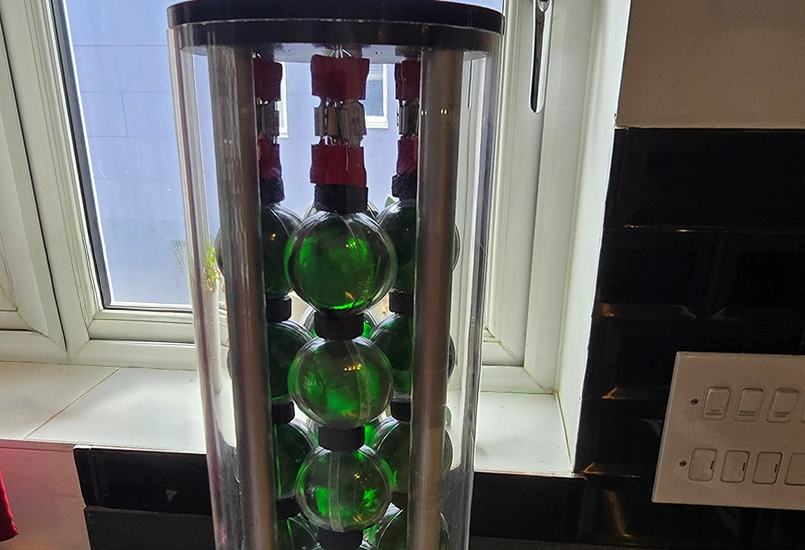
In the film, VX is represented by loose strings of glass baubles. That approach was rejected immediately. Loose components would not survive handling, transport, or live gameplay. The decision was made to fully enclose the VX within a clear acrylic tube, accepting a loss of strict film accuracy in exchange for durability.
Each canister contains four strings of twelve baubles. That meant producing nearly one hundred individual units including spares. Liquid was ruled out due to leakage, breakage, and cleanup risks. Instead, transparent green resin spheres were printed and sealed inside clear plastic baubles.
To preserve the liquid-like appearance, the resin spheres were inserted uncured and then UV cured inside the sealed baubles. This retained the glossy look without sanding or polishing and removed any risk of spills.
Stringing the baubles was the most demanding part of the entire project. Fishing line was used for its strength and invisibility, but it constantly resisted alignment and wanted to coil. Between each bauble sat a custom spacer with four holes, requiring four lines to be threaded, tensioned, and fixed twelve times per string.
A custom 3D printed jig became essential. It held baubles and spacers in alignment while threading and gluing took place. Even with the jig, the process was slow, repetitive, and mentally draining.
This was not complex work. It was precision repetition at scale, and that is often worse.
The acrylic tube and aluminium support rods were straightforward to source and matched the internal layout of the film prop closely. The failure came in assembly order.
Initially, the bauble strings and rods were assembled directly into outer caps. This meant fighting fishing line tension while aligning rods and gluing caps in place. When one canister was dropped during use and a cap partially failed, the design flaw became obvious.
The solution was a redesign. Inner caps were added to permanently hold the bauble strings and aluminium rods as a single internal structure. This assembly could then be slid into the acrylic tube and sealed with outer caps. The redesign simplified assembly, improved repairability, and removed unnecessary frustration.
At the top of the bauble strings, paired spade connectors were used to imply an electrical detonation system. A small compartment housed a 9V battery and a rocker switch with an integrated LED. The switch had one purpose. Green light on meant armed. Off meant disarmed.
There were no removable targeting cards or complex electronics. Anything detachable would eventually be lost or broken. The switch provided a deliberate interaction step without adding fragility.
In play, the prop exceeded expectations. Players immediately recognised it and handled it with extreme care. Narrative lines borrowed from the film reinforced the danger. Drop it and you die. Disrespect it and you die.
Unlike rugged props that invite abuse, this one looked fragile and final. Players slowed down, communicated clearly, and treated it as genuinely dangerous. That behavioural shift was the real success of the build.
The prop works. It looks right. It creates tension. It will never be built again.
The cost was paid once. Any future version would require someone else to thread the 100 baubles with 4 threads of fishing line 8 times!
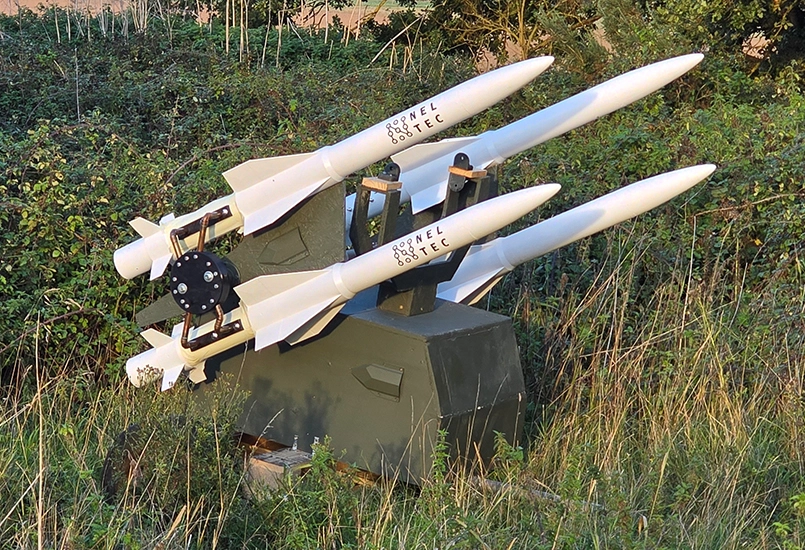
Missile launcher replica based on the Rapier air defense system, built using plastic pipes and 3D printing.
Read more