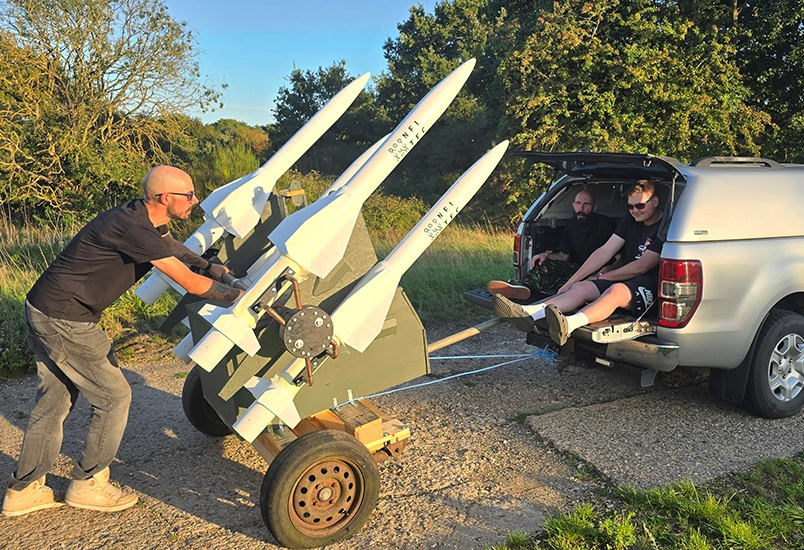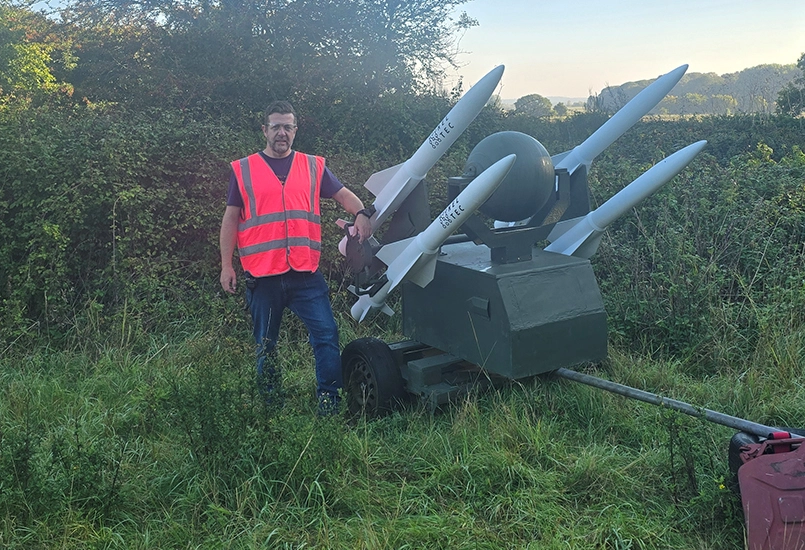
Missile launcher replica based on the Rapier air defense system
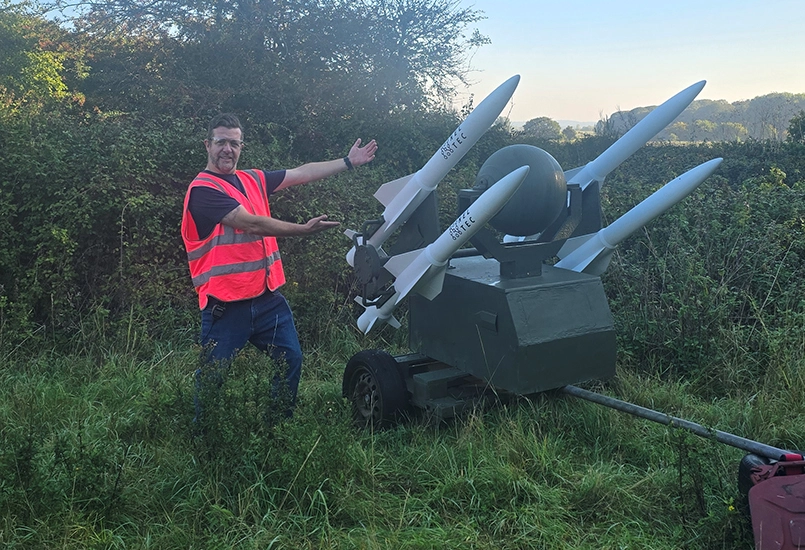
Gumman Airsoft at Tuddenham works because it feels inherited. The abandoned RAF buildings, improvised defences, and reused industrial junk give the site its identity. The intention with the Rapier launcher was to add another permanent feature that belonged to that language rather than competing with it.
Other sites lean on spectacle like tanks, buses, or helicopters. Those can work, but they always feel imported. A missile system felt more plausible for a former RAF base. It reads as Cold War residue rather than entertainment.
The launcher was never meant to be a novelty prop or a one-day gimmick. It needed to live on site long term and still make sense six months later.
The build followed a simple rule used across many projects. What does it look like from 10 metres away?
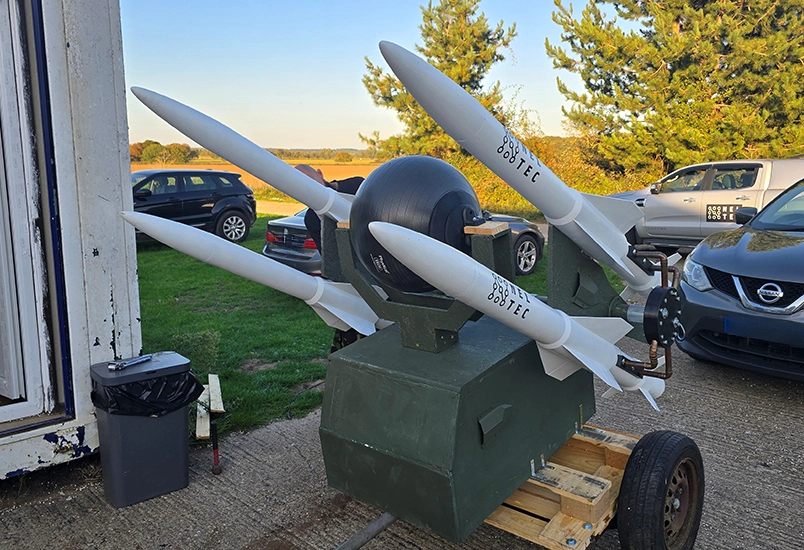
At roughly one-third scale, the launcher instantly reads as a missile system even to players who do not know what a Rapier is. White missiles, aggressive launch angles, a central radar dome, and muted military colours do the work. Accuracy mattered far less than silhouette and proportion.
Branding was fictional and deliberate. Nel-Tec markings tie the launcher into existing storylines without referencing real-world military units.
The launcher frame and box were constructed from wood using proportions taken from a Rapier STL model. The file was used as a visual reference rather than a blueprint, helping guide angles and overall shape without forcing precision engineering.
The structure is fixed. There is no elevation or rotation. That decision avoided mechanical failure and kept the build robust enough to survive weather, players, and time.
Transport was improvised rather than elegant. A donated car rear axle, seized wheels, and a tow bar were used to drag the launcher into position. Once placed, it was intended to stay put.
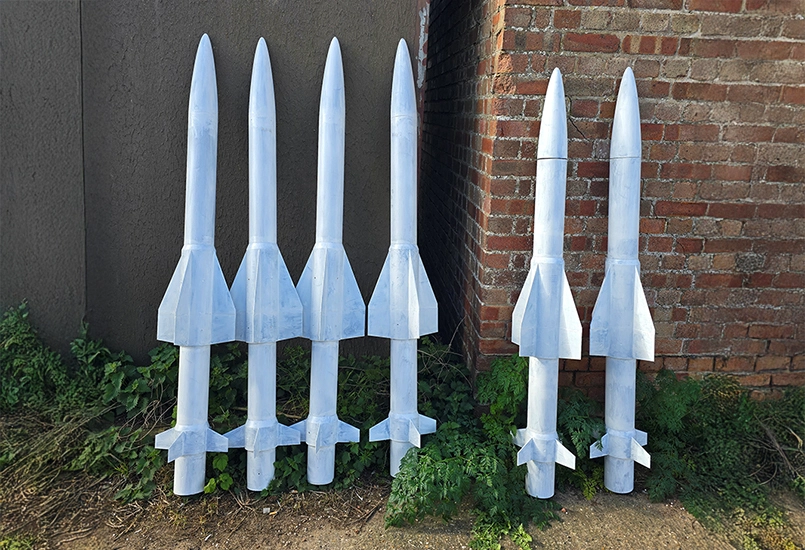
The missiles were built from found soil pipe discovered on site. This choice solved scale, rigidity, and availability in one go. Custom nose cones and fins were modelled and printed to slide over the pipe, then mechanically fixed rather than bonded.
Mounting was handled using copper plumbing pipe with soldered joints, passing through the missile bodies and clamped to a steel pole running through the launcher. It looks improvised because it is, and that works in its favour.
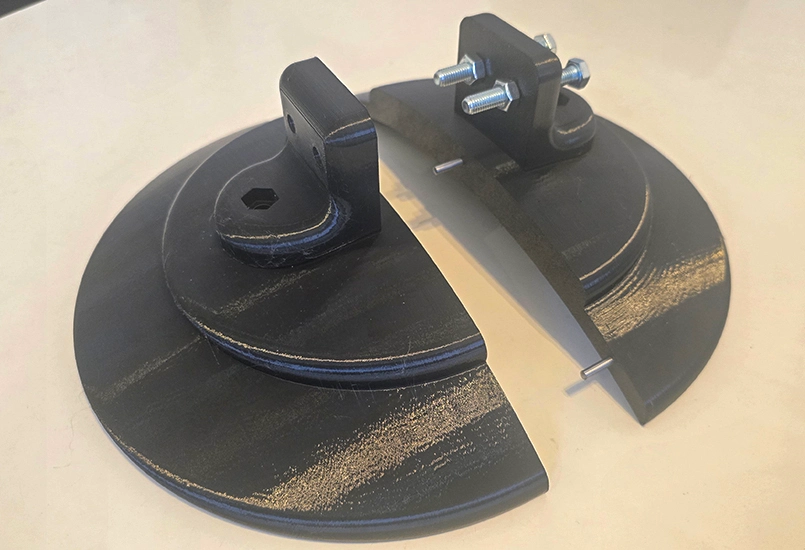
The radar dome is a yoga ball held in printed cups. From a distance it sells the illusion completely. Up close, the reveal becomes part of the charm.
Paint was the main compromise. Military-grade green performed exceptionally. The white missile paint did not. Multiple coats of cheaper paint cost more time and effort than buying the right material upfront.
The launcher succeeds as site architecture. It feels permanent, believable, and integrated rather than decorative. Its placement alongside the radar installation reinforces that it is part of a system, not a standalone prop.
Its limitations are clear. It is static, heavy, and not designed for repeated relocation. That was an acceptable trade-off for durability and presence.
The key lesson is restraint. Not every prop needs to do something. Sometimes it only needs to exist convincingly and let players fill in the rest.