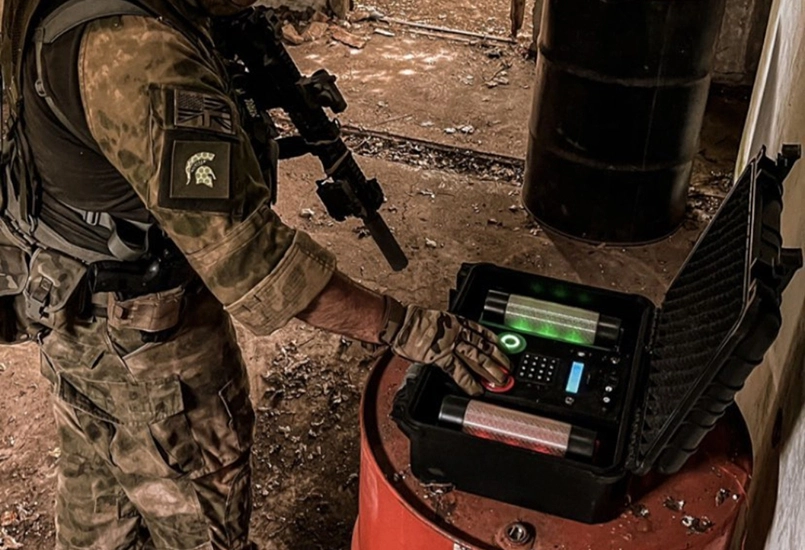
The M-COM started as a simple experiment and turned into something that fundamentally changed how airsoft games were played.
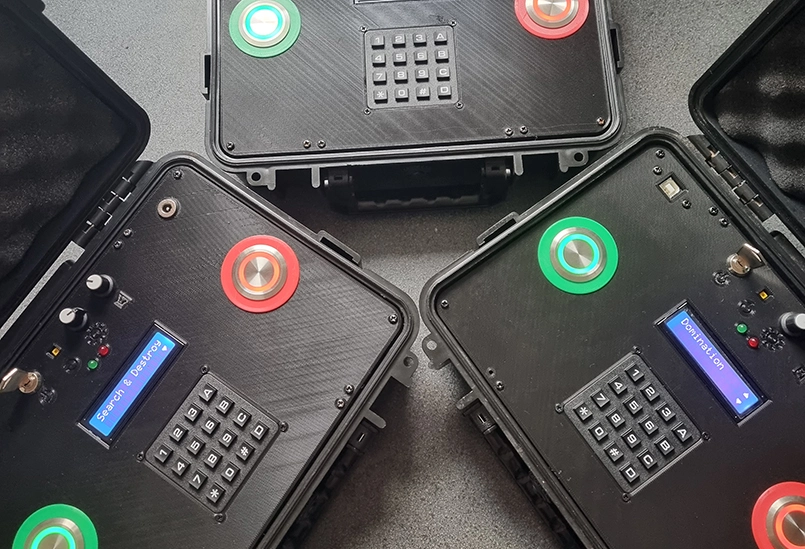
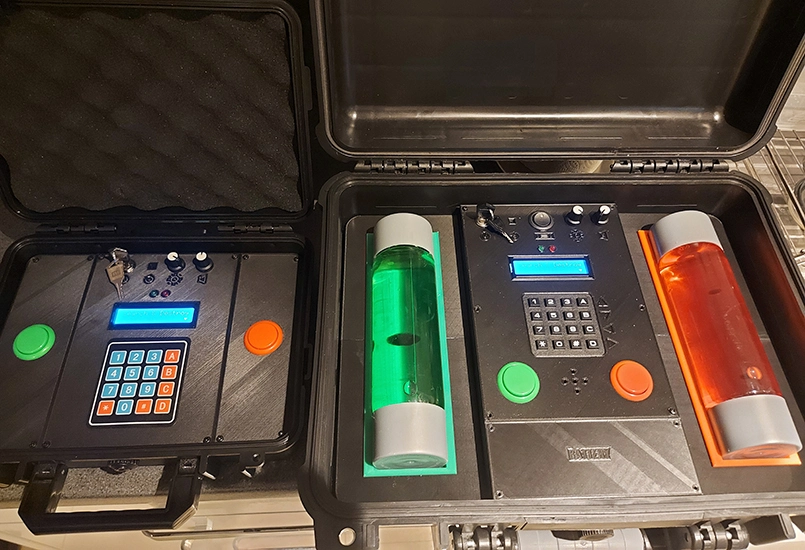
The original idea came from seeing an M-COM-style device on Instructables, built around an Arduino and a handful of basic game modes. At the time, most airsoft objective games relied on flags, cones, or static markers. They worked, but they were abstract. There was no tension in interacting with them, no consequence beyond “touch it and move on.”
The first M-COM was built to fix that. The goal was simple: create an objective that players had to commit to. Something they had to stand over, defend, and interact with while under pressure.
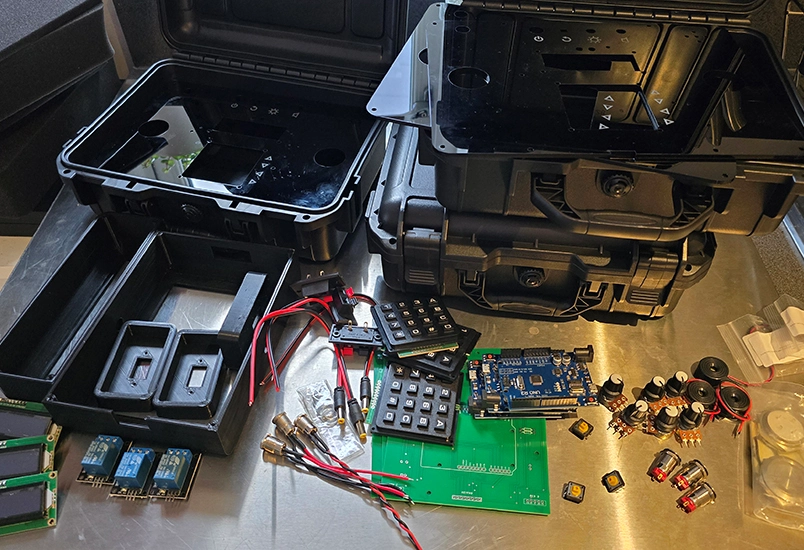
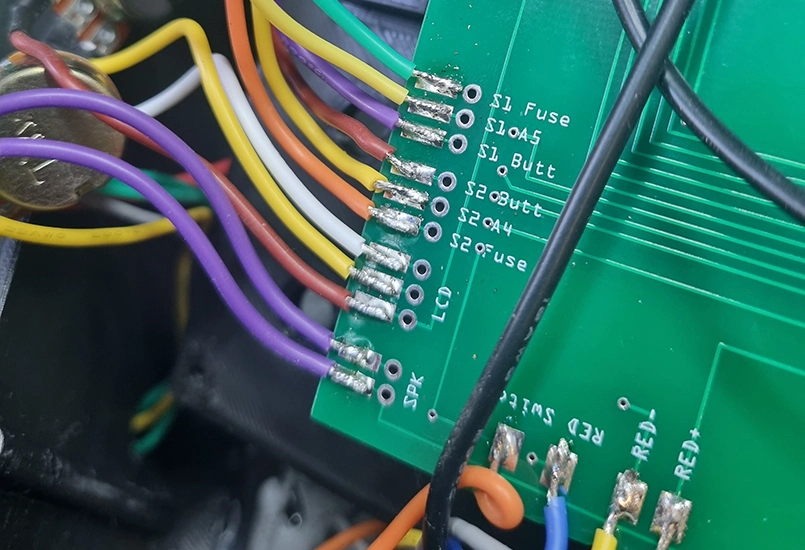
The earliest version was crude. A large waterproof equipment case housed an Arduino, an LCD screen, a keypad, and oversized red and green team buttons. Everything inside was hand-wired. If you opened it up, it looked like a plate of multicoloured spaghetti. It worked, but it was fragile, difficult to maintain, and painful to modify.
That version taught the first important lesson: if something is awkward to build or repair at home, it will be impossible to fix in the field.
The next iteration introduced a custom PCB designed in Fritzing. It was not elegant, but it allowed modules to be plugged in cleanly instead of soldered point-to-point. That one change made the entire system maintainable.
The second lesson came from field use.
Airsoft is not gentle. Props get dropped, kicked, shot, stood on, rained on, overheated, and left in the sun. The first internal parts were 3D printed in PLA, under the assumption that the outer case would protect them. That assumption was wrong.
PLA softened and deformed in summer heat. Arcade-style buttons failed when water got inside them. Condensation built up inside closed cases after wet games and quietly destroyed electronics in storage.
Every failure forced a redesign. PETG replaced PLA for structural parts. Laser-cut acrylic replaced printed fascia panels. Waterproof switches replaced anything that could wick moisture into the enclosure.
Durability stopped being a feature and became the entire design process.
The single worst failure happened during a live game.
A player threw a smoke grenade to block access to the M-COM. The smoke landed directly on top of the device and burned there for several minutes. Hot, dense smoke poured into every gap and seam. By the time it was safe to approach, the M-COM was effectively destroyed.
That incident changed how the device was treated forever. From that point on, every design decision was made with the assumption that someone would eventually put something hot, heavy, wet, or stupid on top of it.
If it could not survive that, it was not finished.
As the hardware improved, the M-COM stopped being an experiment and became a central game mechanic.
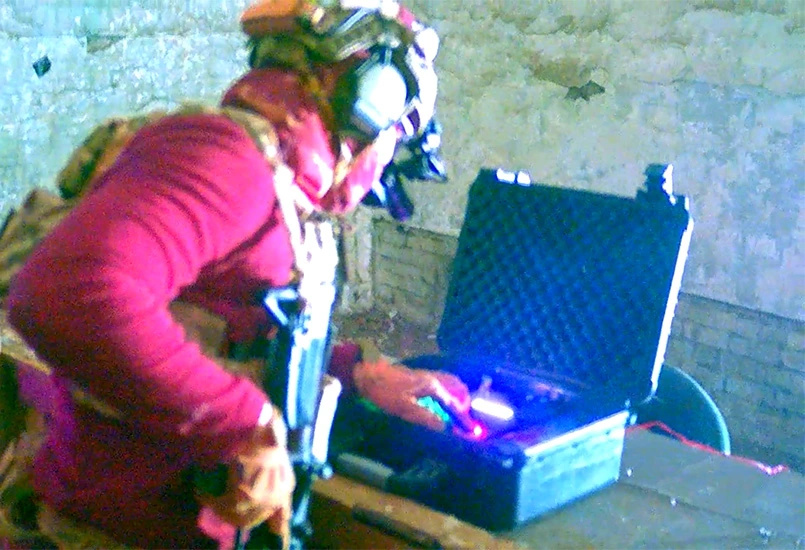
Sites began building entire scenarios around it. Domination games where multiple M-COMs had to be held simultaneously. Search and Destroy games where teams had to arm and defend a device under fire. Bomb-defusal scenarios where a countdown, sounds, and flashing lights created real urgency.
The biggest difference compared to traditional objectives was commitment. Holding a button for thirty seconds while under fire feels like a lifetime. Players fight harder when the objective demands their presence instead of a quick touch.
Seeing those moments play out on the field is where the real satisfaction comes from. Watching teams battle over the device in the final seconds of a game, knowing that the outcome depends on whether someone can hold their nerve long enough, makes all the effort worthwhile.
Over time, a clear philosophy emerged.
Wireless systems, phone-based interfaces, and clever tech were all considered and mostly rejected. Every extra layer of complexity introduced another failure point. In an environment where things get dropped in mud and shot at, reliability matters more than elegance.
Big buttons are better than small ones. Physical fuses are harder to lose than tiny tokens. A device that can “blow up” is more engaging than one that only beeps.
If there is one assumption that proved consistently wrong, it is this: no matter how strong you think you have built something, it is not strong enough.
Airsoft players will find ways to break props without trying to. The only defence is overengineering and testing in ways that feel unreasonable. Drop it. Stamp on it. Leave it in the rain. Put it in the sun. Assume someone will throw a smoke grenade at it.
The M-COM is not a product and was never intended to be one. It is a learning process captured in plastic, wire, and code. Each version exists because the previous one failed in some unexpected way.
And that, more than anything else, is what makes it worth documenting.