Interactive lightbox with button and LED effects for night time airsoft game scenarios
The Gunman Airsoft Tuddenham site includes twelve abandoned RAF buildings that regularly form the backbone of objective based games. During daytime play, building clearance is easy to observe and manage. At night, that clarity disappears. The site has no mains power, generators are impractical for scattered locations, and traditional portable lights either flood areas with harsh white light or break immersion. What was missing was a way to illuminate spaces subtly while also communicating game state clearly to players, marshals, and spectators.
Rather than treating lighting as a utility, the project treated it as part of the gameplay. The core idea was simple. A building starts in one colour state and changes to another once an objective is completed. That visual change should be readable from both inside and outside the building. Building clearance became the primary design driver, with red and green forming the default visual language, but the system needed to remain flexible enough to support other scenarios and colour combinations.
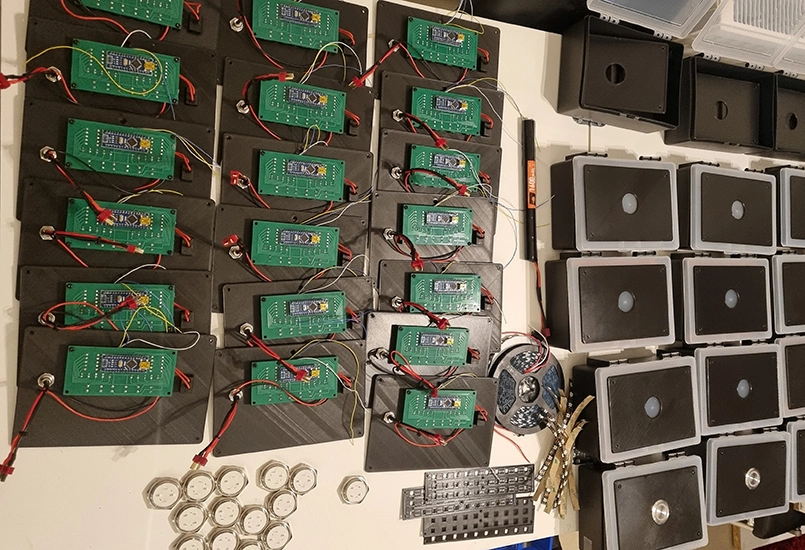
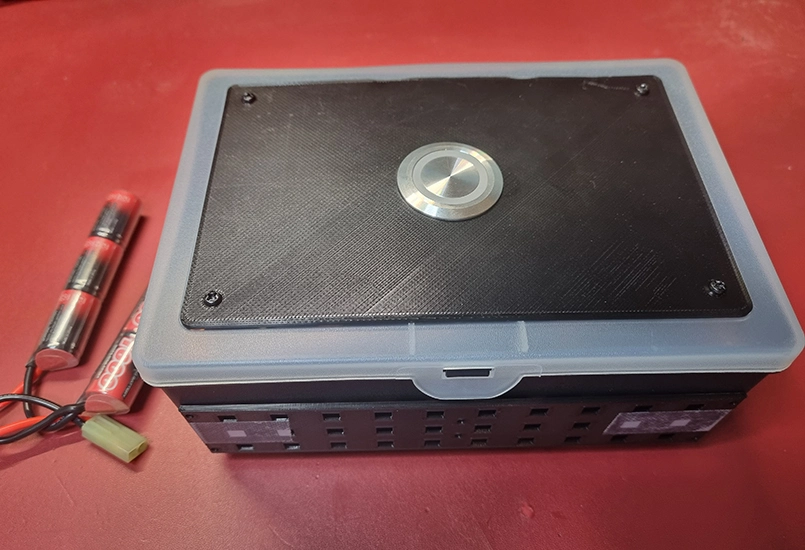
Each lightbox was built around an Arduino Nano, chosen for its size, simplicity, and reliability. Illumination came from addressable RGB LED strips, commonly known as NeoPixels, mounted in banks along the top and bottom of the enclosure. This created an ambient glow that washed the surrounding surfaces rather than acting as a directional light. Power was supplied by airsoft NiMH crane batteries, a deliberate choice due to their robustness, safety, and ease of charging in field conditions.
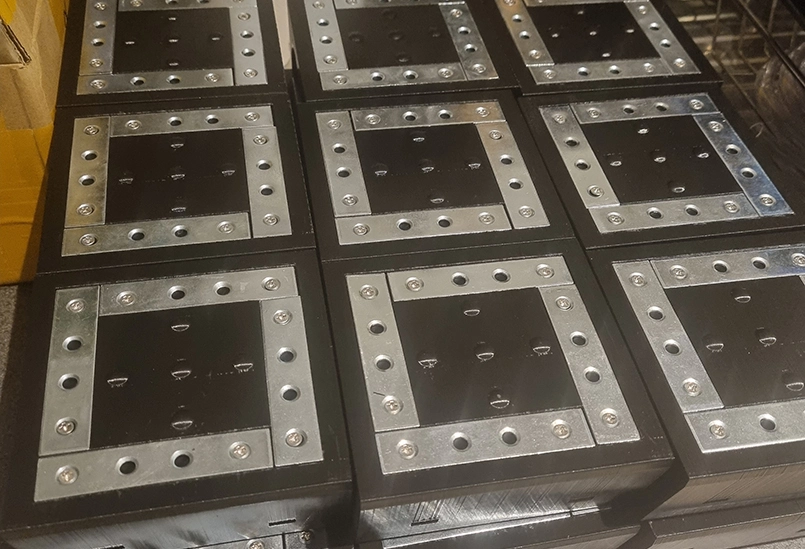
The enclosure itself was a lightweight plastic compartment box, originally intended for indoor storage. Inside, a 3D printed insert held the electronics securely and presented internal controls for selecting the two active colours. Externally, a single large illuminated metal button provided the only player interaction. One press toggled the light from one colour to the other. No menus, no modes, no ambiguity. Magnets mounted to the rear allowed the box to be fixed to steel beams, containers, barrels, or any metal surface around the site, regardless of orientation.
Although the site only required twelve units for the village buildings, twenty lightboxes were built. This allowed for spares and for the system to be used elsewhere on the site. Beyond building clearance, the boxes proved useful for marking zones, objectives, and points of interest using different colours. Deployed across the village at night, the effect was immediate and striking. Buildings visibly transitioned state over time, giving players constant spatial awareness without relying on shouted calls or marshal intervention.
From a gameplay perspective, the lightboxes were a clear success. Players understood them instantly and interacted with them correctly without explanation. The main weakness revealed itself over time. The plastic enclosures were never designed for rough handling. While they tolerated BB impacts without issue, drops and heavy handed handling caused cracked lids and damaged housings. The exposed LED strips also suffered when units were used outdoors in damp conditions.
The system remains fully functional in concept and electronics, but durability has reduced the active fleet. Around half of the original units now require repair. With another major night game cycle approaching, the open question is whether to simply repair what exists or redesign the enclosure entirely using a more robust housing. The mechanics themselves need no improvement. The Interactive Lightbox achieved exactly what it set out to do. Any future iteration would focus on survivability, not added complexity.